Monday, April 9, 2012

Sapucai and the bones of the trains

Sapucai (take your pick on the spelling) - the Scream


The road to Potrero Pucu from Paraguari cuts between two long lines of hills. Ten kilometers before my pueblo of Caballero is the town of Sapucai, which has flourished in the last two years ever since the road that passes it by was asphalted over. The road runs east-west, and in summer the droning whine of cicadas mix with the bone-rattling clatter of 18-wheelers roaring by.


It could be any other Paraguayan campo town but for the workshop and the pint-sized train locomotives scattered about, rusting into decrepitude, a story forgotten and a legacy ignored. But things were not always this way. As with Paraguay’s interaction with the Jesuits, there was a moment of optimism, of a different possibility than the corruption and misguidance which crippled this country for so many years.

A little history though: Paraguay’s first (and maybe most bizarre) dictator, Dr. Francia, took office in 1811. He banned higher education and instituted mandatory interracial marriage. Most importantly, he sealed the country, banning immigration and emigration. These moves forced the mestizo-ization of Paraguay’s population, insuring Francia’s supremacy, but paradoxically forced the country to develop its domestic economy. By the end of Francia’s reign, Paraguay was one of the wealthiest countries in Latin America.

It was at this point that the hombres Lopez (Carlos, and then his son Francisco,) took over and set to modernizing the country. In 1856, they enlisted the help of William Whytehead, an English engineer. Whytehead built the San Roque station in Asuncion, and together they formed South America’s first railway company, “The Paraguay Central Railway.” 

The story goes that Paraguay had the first train, and for a time was the most modern country in South America. Since I started writing this story, I learned that was an exaggeration. 

(The hombres Lopez also brought the country a modern navy, and South America’s first foundry.) Within six years, Paraguay’s train system had laid 45 miles of track in the steamy, subtropical jungle. The first train ran in 1861, a teacup sized screecher named Sapucai, or in Guarani, “The Scream,” for its piercing whistle. It still sits in Asuncion’s central station today.

One of the trains sitting outside the workshop

As the decades passed, the rail-lines snaked south. In 1864, it reached Ypacarai, Cerro Leon, and Paraguari, thirty years later it terminated in Yegros, to the south. Sapucai, completed in 1894, sat a hundred kilometers to the south east. 

Today, the hustle and bustle of the yards is gone. Old locomotives sit forlorn amid overgrown weeds, while cows meander about and cars zip by on the newly paved highway. 

The first day that I visit, it is hot and clear, and the grass glows bright green.

One of my first views of the yards is the old turning table. Like the locomotives, it is decomposing away. The wooden ties between the rails on top are weathered and cracked with age. In the basin below, water puddles with mud and a few stubborn tufts of grass.

Decrepit as it looks, the machinery still works. A friend who has come along grasps a smooth lever arching off one end of the massive contraption, and throws his weight behind it. There is a pause, and then the wheels catch and the massive structure rotates, with nary a sound.

A sign in the middle of the turning tracks comes into view: Ransomes and Rapier, Makers, Ipswich, England.” Most of Paraguay’s rail machinery (and at first, a lot of its human talent) came from England. Sapucai housed them in a gated community of flats called “Villa Inglesa,” a few hundred yards from the work sheds.

Silent inside, but perfectly preserved


The townspeople of this small Paraguayan pueblo have chopped up tracks to serve as fence posts. The chassis of one train sits on long since grass-covered tracks, rusted almost beyond recognition. 

A few yards past, an old railroad crane also rusts into scrap. A sign on one side of the machine says, “Clutches to be out of gear before running crane in Train.” Its boiler has also turned rust brown, and the crane’s main shaft emerges from the thing like a stork’s beak.

Behind the train yards I find my first train, Encarnacion 151. It is an attractive little piece of equipment, painted black, with the Paraguayan flag, a wood hopper attached, looking for all the world like it rolled out of 1875. But in Paraguay, wood-powered engines were used until the lines shut down in 2000.

This is just the exterior of the work sheds. After paying the equivalent of a dollar US, I walk into the old repair sheds, which have been converted into a museum. The site has been cleaned and reroofed, allowing welcome sunlight to stream into the workshops, but other than that, the place has sat virtually unchanged for the last 150 years.


David Martinez Zayas leads me around the sheds. When he isn’t teaching math at the Sapucai’s high school, he sometimes leads tours at the museum.

Some old tools

The train station has been renovated for about a year, David told me. “Everything was black and dark,” David said. “We had no support from the local township, even less from the department capital.”
Now, after receiving funding from a local metallurgical company, it looks less like a museum than a perfectly preserved workstation.

“It’s amazing you can just go see all this rusty machinery that looks like you could just go and use it,” said one of my friends who came along to check the place out.

The rails came to Sapucai for its natural resources, David said.

“The technicians chose Sapucai for its wood and water, which wouldn’t dry up,” David told me. (The workshops draw water from a natural spring that sits on top of some of the nearby hills that ring the town. The gravity fed well was Paraguay’s first running water system.)

At first, Paraguay relied on outside help to run its trains. Then, it decided to run the show in house.


 “If something was broke, they [the engineers] would have to send it to England. Finally, they said, ‘No. we can’t depend on England, we have to be able to repair things here.’”

The extent of the railway, from Asuncion south, and east towards Iguazu Falls

An old list of fares
Many of the people who used to work at the junction still live nearby. While I was in Sapucai, I visited a few. The first former worker of the ferrocarril that I talk to is Antonio Bacilides Belarga Lopez Gimenez, a former carpenter. I arrive at his house on an early Sunday morning. He comes to meet me from his chacra, where he was working. He is wearing macintosh rain boots, and billowing brown pants that would better fit him if he gained 40 pounds. But he has an easy smile. His shirt is plaid, and a straw hat crawls down over his ears.

Lopez, 73, started working for the railroad in 1974, and continued there for 23 years.

He is slow to talk about the train, and we are at cross purposes, talking in Guarani and Spanish while I try to convert it all to English. But there are small snatches of pride in the conversation that point to what it must have been like, an institution of regularity and semi-modernity in a country that, at the time, was anything but.

“The workshop was the biggest in Paraguay. It was the lung of the railway,” he said. “Here, we made 
everything and sent it to the other stations [in Asuncion and San Roque.]”

“There wasn’t other [reliable] work,” he said. “And there, they paid monthly.”

Now, the asphalt road links the town to the capital. But until just two years ago, the only ways to reach the town were through the train, or a 25km dirt track from the town of Paraguarí.

“When it rained, buses wouldn’t come,” he said. “But the train never failed.”

There was the everyday rhythm of the place. A huge clock hung at the train yards. Every morning, it let out a blast an hour before work started. The workers shifting in their beds, drinking down maté and cocido. A second blast, half an hour before work began, and then they are hustling out of their houses to get to the yards, the clock whistling twice more as the beginning of the work day approached.

Those were the things that mattered, the memories that remain, he said. I asked him what he liked best, and he without even thinking, he said, “My favorite thing was eating breakfast with my brother and my friends in the mornings.”

At 11:25, the clock would whistle again, and they would have five minutes to lay down their tools and wash their hands before lunch. Then, an hour break, followed by four more hours of work.

The trains pulled out of Sapucai at 6 every morning for Asuncion and at 3pm for Encarnacion. When he talks about it, Lopez gets downright wistful.

“It was like a big party. People went to sell things, they went for curiosity.”

And then the party ended. At the end of the 90’s, the rail service began getting cut back. Mario Gonzalez also worked at the junction. The trains hadn’t had any substantive modernization in the 140 years it ran – it still was using wood powered trains and steam powered workshops. The rail infrastructure was pretty much the same as had been used in the past, and began to wear out. When a gas powered train carrying 60 wagons came through from Argentina, it went straight off the rails, he said.

“They couldn’t handle the weight or the velocity of the train,” Gonzalez said.

There was talk of restoring and rejuvenating the line, he said. The king of Spain visited, and pledged millions for the project, but it never materialized. Japan was also interested, allegedly. “But they didn’t want to give money because of the corruption [here],” he said.

“Political interest is what damned it,” he said.

As in the states now, the train transported freight at significantly cheaper prices than the truckers. “It was only half as expensive as trucks!” Gonzalez said. The massive (relatively) effort put in to create a transnational train system went to waste, and now rails, stations, and locomotives around the country lie derelict, disappear under the weeds. And so a national treasure sank into oblivion. 

It's not a bad metaphor for the country as a whole, this beautiful place which has until recently suffered through so many mishaps.

Wednesday, April 4, 2012

A former Volunteer just posted this on Salon

This is a pretty gripping account of one PCV's trials in Paraguay when a relationship went south. You might find it interesting

http://www.salon.com/2012/04/03/my_peace_corps_nightmare/

So, a quick note on my follow-up

In a little over a week, I will leave Potrero Pucu for good. I'll be heading stateside for a day, before flying to Nepal and India for two months. (With an option for more!)

More important than that, however, is that I have a follow up. Her name is Amy, and you can see the hand off below. (You can tell she's new because her skin doesn't look like peachy, sun baked leather, and because she still radiates enthusiasm and naivete!)


I'm extremely pleased with my bosses for putting her here. She's 26, and the daughter of missionaries. She lived in Mexico from age 4-18, so she speaks perfect Spanish and will have a much easier time communicating right off the bat, and she can start getting the Guarani going immediately. She's excited to follow up on fogons and working in the schools in my zone, which is also great news.


Like all guapo volunteers, Amy has a blog, and she's been posting about her experience going through training, and getting ready to swear in as a Volunteer (which will happen on April 20th). She'll arrive at Potrero Pucu on April 24th, and be dividing her time between PP and Pirayuvu, a community of 35 houses about three kilometers north of mine.

If you want to keep following the news and happenings in Potrero Pucu, check out her blog at http://aheimberger.blogspot.com/.

CONGRATS, AMY!

Monday, April 2, 2012

So you were in the Peace Corps... What did you do?

At the end of Service, Peace Corps Volunteers have to write a DOS - a description of service. It's the only official document that we take with us saying what we did. I have, for your enjoyment, copied and pasted mine below. It's in legalese, so beware...


Description of Peace Corps Service


St. John Barned-Smith

Republic of Paraguay 2010-2012


After a competitive application process stressing technical skills, motivation, adaptability, and cross-cultural understanding, Peace Corps invited Mr. St. John Barned-Smith to serve as a Rural Health and Sanitation Extension Volunteer in the South American nation of Paraguay.

Pre-service training


Mr. Barned-Smith began an intensive 11-week Pre-Service Training on February 10th, 2010, in Guarambaré, a small agricultural town located 45-minutes south of the capital, Asunción. The training program consisted of preparation in language and technical skills, common area studies, health, and safety and security.

Training program included:
  • 157 hours of formal Language training of spoken and written Spanish and Guaraní. 
  • 98 hours of area studies (the history, economics, and cultural norms of Paraguay as well as personal adjustment, safety and security, and health training).
  • 182  hours of technical training including: dental health education, parasite prevention and education, nutrition education and cookstove promotion, HIV/AIDS awareness, reproductive health, latrine construction and garbage pit promotion, protection of water sources, health census design, community mapping, community study techniques, and promotion of health commissions/groups
  • In addition, as part of the language and cross-cultural component of the training program,   lived with a Paraguayan family for 11 weeks.

Description of Primary Projects/Activities


On April 30th, 2010, Mr. Barned-Smith completed training and was sworn in as a Peace Corps Volunteer. He was assigned to Potrero Pucú, a community of ab0ut 40 houses located in the department of Paraguarí, roughly 100 km southeast of Asunción.

A first-time Volunteer, Mr. Barned-Smith served as an ambassador to Potrero Pucú and the area around it. He was the first American to work with the community as a Peace Corps Volunteer in approximately 30 years. In addition to his health and sanitation work, he spent a significant portion of his service teaching his community about the role of Peace Corps and about the United States, as well as sharing Paraguayan culture with Americans. This included making inroads with community leaders and individual families, and also helping expose the site to American culture and prepare it for work with future Peace Corps Volunteers.

After his arrival at site, Mr. Barned-Smith conducted a community-wide health census of Potrero Pucú. The census, which he later shared with the community’s neighbors’ commission, demonstrated that the majority of the adult inhabitants of Potrero Pucú suffered from high blood pressure and similar conditions caused by factors like lack of exercise and poor nutrition and cooking practices. Throughout his service, he worked to address these problems through cooking classes, exercise camps, and the promotion of cookstoves, which made for safer and healthier cooking environments for the community’s women – many of whom cooked on the floor in smoke-filled kitchens.

Mr. Barned-Smith also focused on basic health education with the community’s youth at Potrero Pucú’s grade school and high school, and a grade school in the neighboring village of Pirayuvu. He taught students from kindergarten to 11th grade about a variety of health topics, including dental health, parasite prevention, hygiene, nutrition, and self-esteem and life skills classes. He implemented a tooth-brushing program, and helped the school design, build and cultivate a school vegetable garden.  Mr. Barned-Smith also promoted parasite prevention and instructed over 150 elementary school students and teachers during World Hand-Washing Day on the importance of proper hand-washing. He taught students and families how to make homemade soap and construct hand-washing stations.

A central theme in Mr. Barned-Smith’s service was nutrition and physical fitness.  He cooked regularly with approximately 15 Paraguayan families, where he emphasized the use of healthier and cheaper ingredients such as soy or home-grown vegetables instead of Paraguayan staples like meat or imported produce.  He worked with five families to build gardens or work more effectively in gardens they already had. He also helped promote aqua-farming and other protein sources as alternative.

Apart from his work promoting gardening and healthier food preparation, Mr. Barned-Smith also worked extensively with Paraguayan families to make their cooking environments safer and healthier. Many Paraguayan women cook over open fires. Mr. Barned-Smith promoted the use of brick cookstoves, or fogones, which allowed the women to bake their foods instead of relying on frying as their main style of cooking. The cookstoves also enclosed the fire and lowered the amount of smoke present in the kitchen, thereby helping reduce burns and respiratory infections. During his service, Mr. Barned-Smith constructed (or helped construct) 16 cookstoves.

Mr. Barned-Smith also worked to improve the quality, affordability and efficiency of the cookstoves built by Peace Corps Volunteers and Paraguayans. Mr. Barned-Smith and other volunteers in the department of Paraguarí designed more efficient and economical models of cookstoves, and used a grant from the Energy and Climate Partnership of the Americas to construct these models in rural Paraguayan towns throughout the department.  The cookstove reduced the amount of smoke present during the cooking process, and used (in some cases) 40% less wood than older models. He also helped produce an instruction manual for the design, which was incorporated into Pre-service training.

By the end of his service, 20% of the families in Potrero Pucú were able to cook with more healthy stoves through Mr. Barned-Smith’s efforts. Mr. Barned-Smith also promoted the use of cook stoves in the neighboring community of Pirayuvu. Working with a group of neighborhood women, he created a health committee and supported it in its goal to raise money to build cook stoves in approximately 15 houses throughout the community.

Mr. Barned-Smith worked extensively with Potrero Pucú’s residents to bring running water to the site, only half of which had access to reliable running water. During his time in Potrero Pucú, Mr. Barned-Smith helped lay and repair piping that supplied water to half of the community’s houses. He also supported the commission in fundraising and at its meetings.

Mr. Barned-Smith also hosted a series of sports camps at his community’s school and worked with other volunteers in other sites to teach local youth about American sports and promote physical fitness. In Potrero Pucú approximately 50 Paraguayan youth learned the fundamentals of American football, baseball, and Frisbee in workshops over several months.

In addition to his work in Potrero Pucú, Mr. Barned-Smith assisted in Peace Corps Rural Health and Sanitation Pre- and In-service trainings.  During these sessions, he trained incoming volunteers on nutrition, soap making, gardening, and cultural adaption.  He hosted trainees at his site four times over the course of his service, focusing on cultural integration, teaching, and nutrition. He also helped win a grant from The United States President's Emergency Plan for AIDS Relief to train approximately 25 Paraguayan youth as HIV/AIDS awareness and prevention outreach workers.

Description of Secondary Activities/Projects


Although officially assigned as a Rural Health and Sanitation Volunteer, Mr. Barned-Smith worked on a variety of secondary projects.  Mr. Barned-Smith educated Americans about Paraguayan culture and life through a variety of methods – the most important being his blog, www.sinjininparaguay.blogspot.com. (THAT'S YOU GUYS!) A journalist by training, Mr. Barned-Smith shared stories and photos about his work, the people of his site, his travel experiences, and the challenges and adventures of his service. During his two years in Paraguay, Mr. Barned-Smith’s blog received close to 9,000 visits from 86 different countries. He wrote several articles for stateside newspapers and blogs concerning Paraguay’s history and culture, including The Philadelphia Inquirer. (COMING OUT IN THREE WEEKS...) On a visit home, he also gave presentations on Paraguayan culture and Peace Corps’ mission.

In an effort to promote more sustainable and profitable agriculture, Mr. Barned-Smith hosted a workshop in Potrero Pucú on the cultivation of natural Paraguayan yuyos, or herbs.

Mr. Barned-Smith taught English as a Second Language classes during his service to the community’s teenagers.  He used the classes to increase the students’ knowledge of the language and American culture by sharing food and stories from the United States.  Mr. Barned-Smith organized activities to raise cultural awareness of the United States with members of the community as well. Outside of the school, he celebrated holidays such as Thanksgiving with foods traditionally consumed by people in the United States. 

Mr. Barned-Smith also helped the students of his school construct a World Map. Over the course of several weeks, he taught geography and mapmaking, which culminated in a wall sized map that adorned one of the school’s exterior walls. He also helped paint two other maps in other volunteers’ communities.


Language Skills


Mr. Barned-Smith achieved an Advanced High competency level in Spanish during his service and used Spanish in his work at school, with his colleagues, Paraguayan community contacts, and in daily life.  In addition, Mr. Barned-Smith achieved an Advanced Low competency level in Guarani, Paraguay’s indigenous language spoken by more than 90% of the country. As with Spanish, he spoke Guaraní regularly while traveling, teaching, shopping, and communicating with members of his rural community.

Mr. Barned-Smith completed his Peace Corps service in Paraguay on April 15th, 2012.

Saturday, March 31, 2012

Paraguayan Letradismo


Paraguayans often call each other “letrado.” It’s a little difficult to translate directly to English, but “letrado” most nearly means cunning, sneaky, or possibly mischievous. The people here talk about small precocious children as being “letrado,” and it’s a good thing. But with adults, it’s not quite the same, unless it’s said with a smile and a wink, it’s almost an insult. And recently, I was the victim of some very “letrado” behavior. To wit: 

This story starts with Antonio. I’ve written a little before about him. He is short, with a shock of hair more pepper than salt, but which he dyes to hide the gray. He is the director (pronounced “directooor” in Spanish) of Potrero Pucu’s elementary and middle schools.

Like many Paraguayans, he wears other hats: he is also the president of Caballero’s city council, Caballero being my district capital. And of course, he is my contact. He is also one of those back-slappy, trickster types, and he loves to play the mischief maker with me.

One story he is always telling is about the time he invited me to eat some fresh barbecue at his house. I walked the three kilometers to his house only to discover that he hadn’t cooked barbecue at all, but a Brazilian dish called fleichao. (Don’t get me wrong, it’s delicious. It’s just not barbecue.)

Several weeks ago, while I was visiting Victorina and Nestor – my host sister and her husband – in Asuncion, Antonio called at almost 10pm. Twice.

When I called him back, he told me, “Santo, I’ve heard that a couple of people are really angry at you. I need to talk to you tomorrow about how you messed up.” The word he used in Spanish was “fallaste,” or, “you failed.” It was a very strong way to phrase things.

This is the last thing I wanted to be hearing with less than a month before swearing out.  The next day I ran into him and he explained that my host dad had called him that night – totally drunk – and said my house was always dirty and he didn’t want other volunteers living here.

“I’m just telling you because I’m your contact,” he said.

This should have been my first hint that something didn’t smell right.

My host dad – Tesho – doesn’t have a phone. He never talks on one. And he never gets aggressively drunk.
I asked him, he denied it. I asked his daughter, Victorina. She was as mystified as her father. Perhaps Antonio just did it because he felt threatened by my leaving, and wanted to reassert some authority? Perhaps he just wanted a laugh?

In the states, I would have probably blown a fuse, and ripped him for screwing with my head. But in Paraguay, that would just get me a reputation for being disrespectful and disagreeable. So, like I have done so many times before, I swallowed it.

But that incident did remind me that I’d better tidy up my house and lawn for Holy Week.

So I asked around for a couple of weeks, trying – without success – to find someone to mow my lawn.

Then one day last week, I traveled to Zorillakue, to visit my neighbor Alejandra, and help her start painting a world map at her neighborhood school. While I was there I ran into the directora’s husband, a guy named Mingo.

Mingo had cut my host family’s lawn once, I remembered. Oh, Happy Day! We chatted and he agreed to come cut both lawns the next week.

A week later, I was back in Zorillakue painting. Mingo called me from my house, and told me he was starting the work.

“How much are you going to charge,” I asked.

“I’ll do both for 200 mil,” he said.

It physically stopped me in my tracks. Paying 200 mil for a job like that would be like paying 20 dollars for a loaf of Wonderbread. It’s more than three times a typical day’s labor.

“I can’t pay that, Mingo,” I told him.

“Ok, ok, ok,” he said. “I’ll do it for just 180 mil.”

“Mingo, just do half,” I said. “I can’t pay that much.”

Now it’s important to note that prices are pretty standard here. Except in the tourist markets in Asuncion, there isn’t really a lot of haggling. My entire time in Paraguay, I’ve only been ripped off once or twice.

So inevitably, I started over-thinking it. Did I underpay him last time? There’s a lot of lawn, is that work possibly worth that much? And as a foreigner, you get comfortable, but, things are never totally clear-cut here. I'll never know for sure that Tesho didn't borrow my host brother's phone and call Antonio.

When he came to Alex’s house to collect, he asked for 100 mil, which I paid. “It’s probably fine,” I thought. “I’m working for free for his wife, he wouldn’t screw me.”

I arrived at my house to find the lawn not even half way mown. He’d mowed my host family’s, and then done a cursory job on mine.

The final straw was when I found out he had also charged my host mom an additional 50 mil.

“I don’t ever want him back on the property,” I practically spat. (Which is funny, since I’m leaving this country in two weeks.)

I later found out my host dad heard him talking to me on the phone.

“Why didn’t you say anything to him,” I all but yelled at him.

“You’re right to say that to me,” he said, looking distinctly shamefaced.

In the end, it doesn’t really matter. I got played, badly. It’s a phenomenon that happens with Peace Corps Volunteers. You get comfortable, settled into a place, thinking you almost belong. And then something happens to remind you, no, you’re the gringo, and as much as some people like – and even love – you, you’ll never quite be the same as them.

But it's sad to think that even after two years here, you still always have to be on your toes and you can never fully trust people.

Thursday, March 29, 2012

The Seven Sons of Kerana and Tau

The Seven Monsters:
I’ve been wanting to write about some of Paraguay’s myths for a while. Like the Greek myths or the Norse gods, with their gods of mischief and fertility, Paraguay has a rich range of stories. This is the CliffNotes version:

The story goes like this – long ago, there as a beautiful woman named Kerana. She was the daughter of a man named Marangatu, and she loved to sleep. She was so beautiful, though, that an evil spirit named Tau fell in love with her and wanted her for his own.

Tau and Kerana


Determined to have her, Tau transformed himself into a handsome young man, and went to her house, intent on raping her. But he found Katupyry, the spirit of good, waiting for him. The two warred without pause for seven days and nights, Tau consumed with desire for Kerana, Tau determined to beat him back.

Finally, at the end of the seventh night, Tau forced Katupyry to surrender.
Unsatisfied with his victory over Katupyry, Tau then snuck into the place where Kerana was sleeping, and kidnapped her, incurring the wrath of Arasy, the god of Valor. Arasy was so incensed that he damned Tau and all of his children.
Tau and Kerana ended up having seven children, but because of Arasy’s curse, they emerged as loathsome, terrifying monsters.


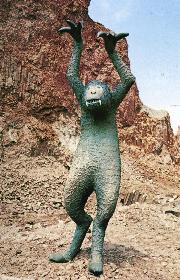
The first was named Teju Jagua, or, the lizard dog. Imagine the Greek monster Cerberus guarding Hades. Teju Jagua could be his Paraguayan cousin. Teju Jagua has the body of a huge lizard, and seven dog heads. Once he grew up, he absconded to the hill near Yaguaron, and hid in its caves, which is where he would drag his hapless victims.

In order to satisfy him, the people made him guardian of the country’s riches.
...
 
The second child-monster was named Mboi Tu’i.

Mboi Tu’i emerged with the body of a snake and the head of an overgrown parrot, with a blood-red tongue. And he emits a terrifying cry which terrifies anyone who has the misfortune to hear it. He is the protector/god of amphibians, and is at home in the suffocating Paraguayan humidity, and the morning drizzle.
…


Moñai was Tau and Kerana’s third child. He is the protector of thieves and mischief-makers. He was born as a monstrous snake, with colorful horns that he used to hypnotize the birds that he hunts. Now, he lives in the swamps and estuaries, and likes to frighten children and make mischief.
…

Next came Jasy Jatere, probably the favorite of the sons. Jasy Jatere “Piece of the moon,” is a small goblin with long, blonde hair and deep blue eyes. He wanders through the fields in the late afternoon, usually naked, carrying a gold cane and bag. If you can steal the cane, he will give gold to get it back, sort of like leprechauns.

He usually kidnaps his victims with his cane, and a high-pitched whistle that sounds like a parrot. His victims are usually children, who he feeds with fruit, honey, and worms, and afterwards, leaves them to play on their own. In the scarier versions, he puts their eyes out. When he finally releases them, they return home empty-headed and silly, and it is for that reason that Paraguayan mothers prohibit their children from playing during the long afternoon.
…


The fifth son was named Kurupi. He is the the god of sexuality, but woe betides the woman he claims as his prize. Kurupi is a dark, hairy monster, with a penis so large that he has to wrap it around his body three times like a belt. The apendage is supposedly prehensile, and so long that he can sneak it into houses  or through windows and violate women without every having to enter the room in which they are sleeping. He is profligate and indiscriminate, taking whichever woman or girl crosses his path, and thus blamed for unwanted pregnancies.

He tries to protect his reputation by protecting the animals of the forest, but even so, if you see him circling you, remember, it’s time to run!
 ...


Ao Ao came next. He had hooves like a cow, but the body of a sheep, except he had a snarling, carnivorous head of a wolf. Ao Ao might have looked like a deranged sheep, but he was much taller, and crueler too. The god of Fertility, he supposedly hides in flocks of sheep, and has had many children with the sheep he resembles. 

He is less friendly towards humans – if he comes across any, they suffer a painful and terrifying fate. The only way to escape him is to climb a coco or palm tree, it is the only place he cannot follow his victims.
 ...


The last child was Luisón. He would seem to be the kindest and least monstrous of the children, because he is a shapeshifter, and every Wednesday and Friday, he takes the form of a small dog.


This is a deception. Luisón is the Guaraní version of the angel of death. He likes to wander through cemeteries, and he only satiates his hunger with the flesh of the recently buried corpses.

....................


Most of these photos are of ethnic art. The ones of Mboi Tui, Teju Jagua, and Kurupi are more modern interpretations. They're from around the web.

Friday, March 16, 2012

The Church of Yaguaron

I had a chance to go to the famous Franciscan church in Yaguaron, a town about an hour or so from my house. (It was also the residence of Dr. Francia, one of Paraguay's most infamous dictators.) The church was built by Fray Alonso de Buenaventura and his followers, and allegedly took 60 years to build. the interior is decorated in the Baroque-Guarani style and contains some incredible carvings and paintings.


The exterior of the church


The apostles


Above the altar


The pulpit

NASA Paraguaya

This made my day: a post (in Spanish) about Paraguayans trying to set up the Paraguayan version of NASA. Buried in a post about Paraguay...