Saturday, March 31, 2012

Paraguayan Letradismo


Paraguayans often call each other “letrado.” It’s a little difficult to translate directly to English, but “letrado” most nearly means cunning, sneaky, or possibly mischievous. The people here talk about small precocious children as being “letrado,” and it’s a good thing. But with adults, it’s not quite the same, unless it’s said with a smile and a wink, it’s almost an insult. And recently, I was the victim of some very “letrado” behavior. To wit: 

This story starts with Antonio. I’ve written a little before about him. He is short, with a shock of hair more pepper than salt, but which he dyes to hide the gray. He is the director (pronounced “directooor” in Spanish) of Potrero Pucu’s elementary and middle schools.

Like many Paraguayans, he wears other hats: he is also the president of Caballero’s city council, Caballero being my district capital. And of course, he is my contact. He is also one of those back-slappy, trickster types, and he loves to play the mischief maker with me.

One story he is always telling is about the time he invited me to eat some fresh barbecue at his house. I walked the three kilometers to his house only to discover that he hadn’t cooked barbecue at all, but a Brazilian dish called fleichao. (Don’t get me wrong, it’s delicious. It’s just not barbecue.)

Several weeks ago, while I was visiting Victorina and Nestor – my host sister and her husband – in Asuncion, Antonio called at almost 10pm. Twice.

When I called him back, he told me, “Santo, I’ve heard that a couple of people are really angry at you. I need to talk to you tomorrow about how you messed up.” The word he used in Spanish was “fallaste,” or, “you failed.” It was a very strong way to phrase things.

This is the last thing I wanted to be hearing with less than a month before swearing out.  The next day I ran into him and he explained that my host dad had called him that night – totally drunk – and said my house was always dirty and he didn’t want other volunteers living here.

“I’m just telling you because I’m your contact,” he said.

This should have been my first hint that something didn’t smell right.

My host dad – Tesho – doesn’t have a phone. He never talks on one. And he never gets aggressively drunk.
I asked him, he denied it. I asked his daughter, Victorina. She was as mystified as her father. Perhaps Antonio just did it because he felt threatened by my leaving, and wanted to reassert some authority? Perhaps he just wanted a laugh?

In the states, I would have probably blown a fuse, and ripped him for screwing with my head. But in Paraguay, that would just get me a reputation for being disrespectful and disagreeable. So, like I have done so many times before, I swallowed it.

But that incident did remind me that I’d better tidy up my house and lawn for Holy Week.

So I asked around for a couple of weeks, trying – without success – to find someone to mow my lawn.

Then one day last week, I traveled to Zorillakue, to visit my neighbor Alejandra, and help her start painting a world map at her neighborhood school. While I was there I ran into the directora’s husband, a guy named Mingo.

Mingo had cut my host family’s lawn once, I remembered. Oh, Happy Day! We chatted and he agreed to come cut both lawns the next week.

A week later, I was back in Zorillakue painting. Mingo called me from my house, and told me he was starting the work.

“How much are you going to charge,” I asked.

“I’ll do both for 200 mil,” he said.

It physically stopped me in my tracks. Paying 200 mil for a job like that would be like paying 20 dollars for a loaf of Wonderbread. It’s more than three times a typical day’s labor.

“I can’t pay that, Mingo,” I told him.

“Ok, ok, ok,” he said. “I’ll do it for just 180 mil.”

“Mingo, just do half,” I said. “I can’t pay that much.”

Now it’s important to note that prices are pretty standard here. Except in the tourist markets in Asuncion, there isn’t really a lot of haggling. My entire time in Paraguay, I’ve only been ripped off once or twice.

So inevitably, I started over-thinking it. Did I underpay him last time? There’s a lot of lawn, is that work possibly worth that much? And as a foreigner, you get comfortable, but, things are never totally clear-cut here. I'll never know for sure that Tesho didn't borrow my host brother's phone and call Antonio.

When he came to Alex’s house to collect, he asked for 100 mil, which I paid. “It’s probably fine,” I thought. “I’m working for free for his wife, he wouldn’t screw me.”

I arrived at my house to find the lawn not even half way mown. He’d mowed my host family’s, and then done a cursory job on mine.

The final straw was when I found out he had also charged my host mom an additional 50 mil.

“I don’t ever want him back on the property,” I practically spat. (Which is funny, since I’m leaving this country in two weeks.)

I later found out my host dad heard him talking to me on the phone.

“Why didn’t you say anything to him,” I all but yelled at him.

“You’re right to say that to me,” he said, looking distinctly shamefaced.

In the end, it doesn’t really matter. I got played, badly. It’s a phenomenon that happens with Peace Corps Volunteers. You get comfortable, settled into a place, thinking you almost belong. And then something happens to remind you, no, you’re the gringo, and as much as some people like – and even love – you, you’ll never quite be the same as them.

But it's sad to think that even after two years here, you still always have to be on your toes and you can never fully trust people.

Thursday, March 29, 2012

The Seven Sons of Kerana and Tau

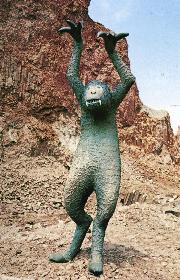
The Seven Monsters:
I’ve been wanting to write about some of Paraguay’s myths for a while. Like the Greek myths or the Norse gods, with their gods of mischief and fertility, Paraguay has a rich range of stories. This is the CliffNotes version:

The story goes like this – long ago, there as a beautiful woman named Kerana. She was the daughter of a man named Marangatu, and she loved to sleep. She was so beautiful, though, that an evil spirit named Tau fell in love with her and wanted her for his own.

Tau and Kerana


Determined to have her, Tau transformed himself into a handsome young man, and went to her house, intent on raping her. But he found Katupyry, the spirit of good, waiting for him. The two warred without pause for seven days and nights, Tau consumed with desire for Kerana, Tau determined to beat him back.

Finally, at the end of the seventh night, Tau forced Katupyry to surrender.
Unsatisfied with his victory over Katupyry, Tau then snuck into the place where Kerana was sleeping, and kidnapped her, incurring the wrath of Arasy, the god of Valor. Arasy was so incensed that he damned Tau and all of his children.
Tau and Kerana ended up having seven children, but because of Arasy’s curse, they emerged as loathsome, terrifying monsters.


The first was named Teju Jagua, or, the lizard dog. Imagine the Greek monster Cerberus guarding Hades. Teju Jagua could be his Paraguayan cousin. Teju Jagua has the body of a huge lizard, and seven dog heads. Once he grew up, he absconded to the hill near Yaguaron, and hid in its caves, which is where he would drag his hapless victims.

In order to satisfy him, the people made him guardian of the country’s riches.
...
 
The second child-monster was named Mboi Tu’i.

Mboi Tu’i emerged with the body of a snake and the head of an overgrown parrot, with a blood-red tongue. And he emits a terrifying cry which terrifies anyone who has the misfortune to hear it. He is the protector/god of amphibians, and is at home in the suffocating Paraguayan humidity, and the morning drizzle.


Moñai was Tau and Kerana’s third child. He is the protector of thieves and mischief-makers. He was born as a monstrous snake, with colorful horns that he used to hypnotize the birds that he hunts. Now, he lives in the swamps and estuaries, and likes to frighten children and make mischief.


Next came Jasy Jatere, probably the favorite of the sons. Jasy Jatere “Piece of the moon,” is a small goblin with long, blonde hair and deep blue eyes. He wanders through the fields in the late afternoon, usually naked, carrying a gold cane and bag. If you can steal the cane, he will give gold to get it back, sort of like leprechauns.

He usually kidnaps his victims with his cane, and a high-pitched whistle that sounds like a parrot. His victims are usually children, who he feeds with fruit, honey, and worms, and afterwards, leaves them to play on their own. In the scarier versions, he puts their eyes out. When he finally releases them, they return home empty-headed and silly, and it is for that reason that Paraguayan mothers prohibit their children from playing during the long afternoon.


The fifth son was named Kurupi. He is the the god of sexuality, but woe betides the woman he claims as his prize. Kurupi is a dark, hairy monster, with a penis so large that he has to wrap it around his body three times like a belt. The apendage is supposedly prehensile, and so long that he can sneak it into houses  or through windows and violate women without every having to enter the room in which they are sleeping. He is profligate and indiscriminate, taking whichever woman or girl crosses his path, and thus blamed for unwanted pregnancies.

He tries to protect his reputation by protecting the animals of the forest, but even so, if you see him circling you, remember, it’s time to run!
 ...


Ao Ao came next. He had hooves like a cow, but the body of a sheep, except he had a snarling, carnivorous head of a wolf. Ao Ao might have looked like a deranged sheep, but he was much taller, and crueler too. The god of Fertility, he supposedly hides in flocks of sheep, and has had many children with the sheep he resembles. 

He is less friendly towards humans – if he comes across any, they suffer a painful and terrifying fate. The only way to escape him is to climb a coco or palm tree, it is the only place he cannot follow his victims.
 ...


The last child was Luisón. He would seem to be the kindest and least monstrous of the children, because he is a shapeshifter, and every Wednesday and Friday, he takes the form of a small dog.


This is a deception. Luisón is the Guaraní version of the angel of death. He likes to wander through cemeteries, and he only satiates his hunger with the flesh of the recently buried corpses.

....................


Most of these photos are of ethnic art. The ones of Mboi Tui, Teju Jagua, and Kurupi are more modern interpretations. They're from around the web.

Friday, March 16, 2012

The Church of Yaguaron

I had a chance to go to the famous Franciscan church in Yaguaron, a town about an hour or so from my house. (It was also the residence of Dr. Francia, one of Paraguay's most infamous dictators.) The church was built by Fray Alonso de Buenaventura and his followers, and allegedly took 60 years to build. the interior is decorated in the Baroque-Guarani style and contains some incredible carvings and paintings.


The exterior of the church


The apostles


Above the altar


The pulpit

Wednesday, March 7, 2012

Building a better mousetrap, Paraguayan style

Families around the developing world use primitive cook stoves to prepare their meals every day. And every year, 2 million people die from illnesses related to those stoves – whether it be from smoke inhalation, or pneumonia, or similar respiratory infections. Look here for an article on the situation.

In Paraguay, and in my site, many families cook on the ground with an open air fire, which fills their kitchens with massive amounts of smoke. Another problem with this approach is it creates a heavy reliance on frying as a cooking method.

During training, Peace Corps taught us how to build better cook stoves. The classic fogon removes smoke from the cooking process, elevates and encloses the fire (so that it doesn’t throw off as much heat or pose a burn risk), and allows for baking since it has an oven.

Unfortunately, they also require three expensive pieces of metal and 250 bricks. They also tend to burn a lot of firewood. If cook stoves were cars, the typical Peace Corps Fogon would be a Cadillac Coupe Deville.

About a year ago, one of my fellow volunteers began tinkering with fogon designs, looking for ways to cut costs and increase the efficiency of the models. Cook stoves are a big topic in the development world, and he came up with a model that uses a “rocket chamber,” which focuses the heat better. You can see how these models are built from the photos.

Rocket chamber. We build a larger box around this sleeve of air and pack it full of ashes to provide insulation and produce a cleaner burn.

In the end, we eliminated 150 bricks and the oven, and brought the cost down by almost half. The model we ended up implementing also burns wood much more efficiently, and produces far less smoke.


Notice the small mouth to this model. A Paraguayan can cook with just a few pieces of wood as opposed to in older models.
The fogon in its entirety.

Monday, March 5, 2012


Life can be frustrating. But I live here:


Love in Paraguay... or, Three Conversations in Five Minutes


This is what it’s really like:

My host family sat under their open-air patio, scattered about on different benches, waiting for the rain. There was a cluster of tobacco scraps around Ña Dora, who was spending the time making cigars. She sliced the long broad leaves with an old razor blade, then packed loose, crumpled leaves into the leaf. Finally, she rolled it into a tube about the length and width of a finger, and used a dab of homemade glue (paste made of flour and water) to hold it all together.
Claudia was passing around a pitcher of terere.

The bullshitting started. The day before, Ña Dora’s son-in-law had brought his sister T with him on a visit to Potrero Pucu. We had all sat around talking in the summer heat until the wee hours of the night. She was single. I was single. The jokes were going to come fast and thick today…

Almost as soon as I sat down, Claudia asked me, “Did T send you a text message?”

(She hadn’t.)

There was three minutes of scattered speculation as to whether or not I was being sneaky and T really did text me. This is one of the elements that has been challenging for me here – assigned sneakiness or mischievousness where none exists.

You get to site, and people say, “Santo is a picaflor (player), he’s got so many women!”

And because I didn’t want to come off as a player, I’d deny having a girlfriend, or say I had one in the 
states, or any other number of things. So then people started saying I didn’t like Paraguayan women, which is another piece of tricky gossip. Sometimes it feels like I’ve been walking a tightrope for two years.

But back to Claudia. She’s probably the most ribald woman in Potrero Pucu, a hair over 5-feet tall, and her belly pops out of too-tight tank tops. She always tries to shock me with her jokes –usually about how she’s going to convince one of my American friends to take her away from her husband and five children.
This is another one of those jarring culture clashes that really doesn’t go away. From where I come from, it would be really weird to make continuous jokes about leaving one’s family and one’s kids. But Paraguay has a “rich” culture built around stuff like that. In fact, it’s totally normal. And there are other things too, like the “Dia de Sombrero,” or “Day of the Hat.” So imagine: Paraguayan men have their legitimate girlfriend, right? Well some days of the week are dedicated to the “official” girlfriend. But “Dia de Sombrero” is for the non-serious girlfriend. I’d guess this probably has its roots from the Triple-Alliance War back in the 1860s. Paraguay found itself caught in a slug-fest between Argentina, Uruguay, and Brazil. It was a charnel-house – Paraguay’s opponents slaughtered 90% of its male population. Men became hot commodities afterward.

This has made dating and couples much more cynical, but alternately, it seems to me, also more honest. Monogamy isn’t really expected – almost every man in my site over 40 has had children with two or three different women. My host mom has had eight children, by three different men. My host dad had two children before they got together. Stateside, we frown on this sort of behavior.

But for the most part, all the children get taken care of. Family units exist more for survival than anything else – women guard the house, take care of it, and raise the children, while men do the heavy lifting in the fields raising subsistence crops.

So there are the elements like Hat Day, and also the “Jakare.” Jakare means “crocodile” in Guarani. But by custom, lonely Paraguayan women (or younger women who still have to live with their parents) left their windows open at night, a welcome to gentleman callers.

What was most infuriating when I got here was how ingrained it was. Women bought into it too, to a certain extent, even going so far as to make jokes about their husbands looking for other women when they (the men) were supposed to be working in the fields. I would tease my host dad when he make jokes that pissed me off. “Tesho, if you get a new girlfriend, you know Ña Dora is going to get a new boyfriend, right? You’re old and fat already!”

They always cracked up. I assumed that it never seemed like more than a parlor trick to them, until one day I overhead Ña Dora telling her neighbor about me and how I’d always defend her. Two years, and finally a shred of self-esteem. I’ll take it.

But let us return to my house, and the people who were ribbing me. Immediately after the joking about the text messages, Ña Dora scolded me.

“You let T sleep on the bench! That was really mean!”

(She just wants to see how badly she can make me blush. It works.)

“But you didn’t send her to my house! Had I but known, she could have stayed there!” I counter. “And you would have just slept, right?” Tesho is nodding sagely. “She’s a pretty woman, Santo.”

“Yup, we would have just slept!” I say.

Tesho shakes his head in disbelief.

For months and months I tried to avoid these kinds of conversations. But I finally embraced them. The only method I’ve found that’s even vaguely satisfying is trying to beat them at their own game. If Ña Dora and Tesho make me blush, or shake my head in surprise, they score a point. If I can make them yelp with surprised laughter, I score a point.

I continue, “Didn’t you see my window? It was open! (It wasn’t.) I was waiting to be jakare-d.” (Everyone cracks up at the idea of a woman playing the crocodile to me, especially since I’ve only dated Americans since I’ve been in Potrero Pucu.)

Then the conversation takes another turn for the weird.

“It’s not going to rain,” I said.

“Yes it will!,” my host brother, Elias, shouts. He’s six.

“No it won’t!”

Then his mother steps in. “Check your balls, Santo,” she said. This is Claudia, the most ribald Paraguayan I’ve met yet.

“If your balls fall, it’s going to rain. If they don’t, it won’t!”

I’m blushing again. Paraguay 2, Santo, 2.

“And look at you, what’s that?” Claudia is on a roll, pointing at a small zit on my cheek. “He’s really horny!”

“I am though,” I shoot back, trying to score a point of my own and catch them off guard.

But Claudia’s not about to be thrown off.

“Victorina (her sister who lives in Asuncion) should take him to a quilombo (brothel) in Asuncion,” she tells Ña Dora, who is slowly dissolving into a quivering ball of mirth.

Tesho won’t stop giggling either.

And finally, the rain starts to fall. Sweet relief, the air cool and wet after six weeks of drought.
Claudia can’t resist one more shot.

“Haven’t your balls dropped, Santo? Check! That’s why it’s raining!”

Paraguay 4, Santo, 2. I’ll give it another shot tomorrow.

NASA Paraguaya

This made my day: a post (in Spanish) about Paraguayans trying to set up the Paraguayan version of NASA. Buried in a post about Paraguay...